Retention automation on a trigger most owners never find in the UI.
A lot of people buy from me without creating an account. I want to win those into accounts.

Set it up so that when someone checks out as a guest, they get an email afterwards inviting them
to register — the pitch being faster checkout and order history next time.

Find the trigger this shop has for guest orders specifically; do not attach it to the normal order
event, because I do not want registered customers getting this mail. Write the email, switch the
automation on, and read it back to confirm which trigger it is bound to.
Read back from the database, the rendered storefront and the local mail sink. No model involved.
| Result | Check | Weight |
|---|---|---|
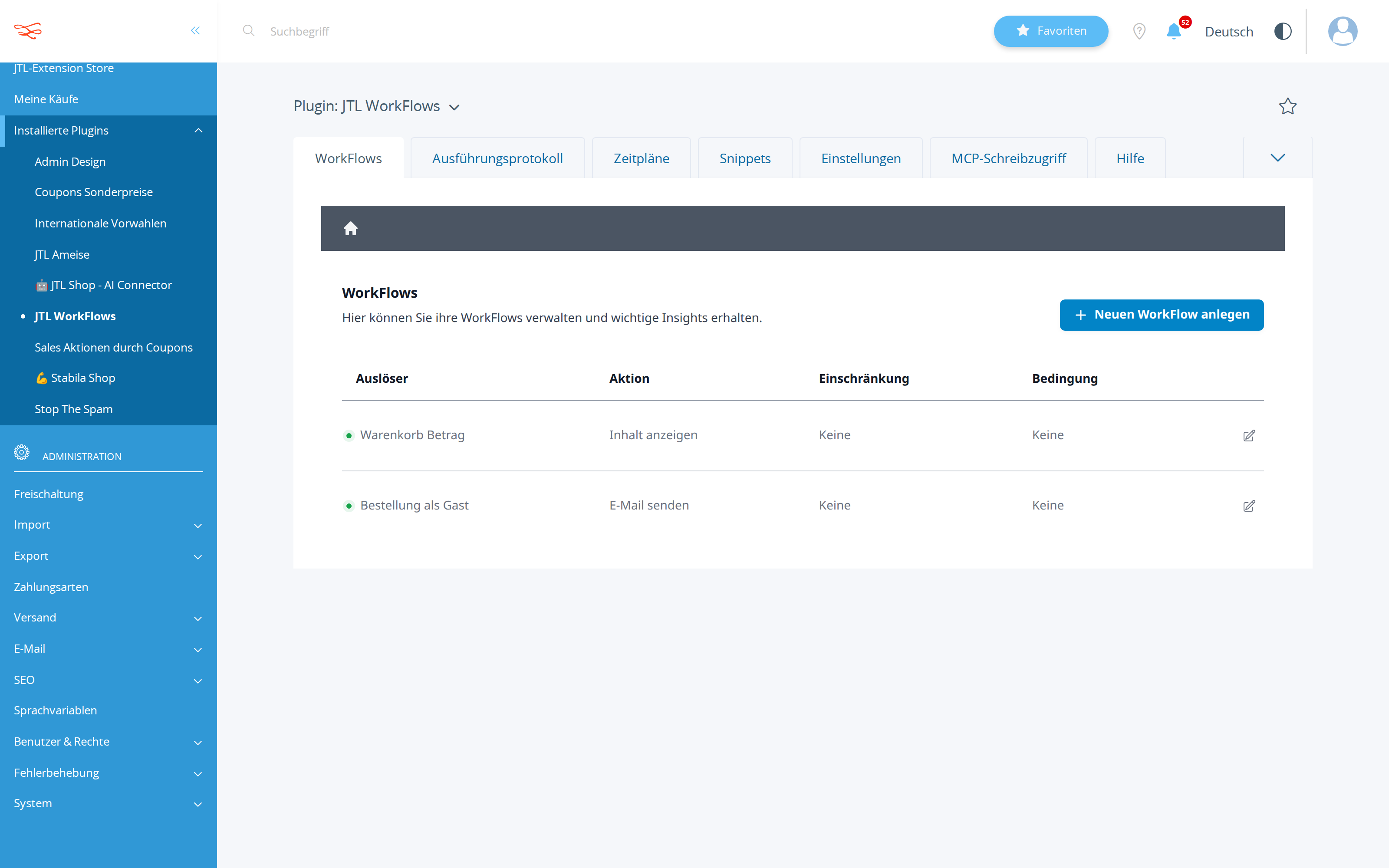
| PASS | A workflow was created on a trigger matching guest/gast created: #3956 orderAsGuest → sendMail |
3 |
| PASS | That workflow is active isActive=1 |
2 |
| PASS | Its action is an e-mail action action=sendMail |
2 |
| PASS | Bound to a guest-specific trigger, not the generic order event triggers: orderAsGuest |
3 |
Scored by opus, which saw only the evidence bundle.
| Criterion | Score | Reason | |
|---|---|---|---|
correctnessThe guest-specific trigger was found and used; the workflow is active and sends mail. |
9/10 | state_diff.json shows workflow 3956 on trigger orderAsGuest with action sendMail and isActive=1, confirmed by the get_workflow read-back in calls.jsonl line 7, with toMail={$customerMail} validated by a dryRun first. | |
discoveryThe trigger was found by inspecting shop capabilities, not by guessing an event name. |
9/10 | It enumerated the live trigger catalog (describe_workflow_capabilities with no args, then {all:true}), pulled the detail record for orderAsGuest, and explicitly compared it against completedCheckout/orderPlaced before choosing — no guessed event name. | |
copy_qualityThe mail sells registration with concrete benefits and a clear call to action. |
6/10 | The HTML body names three concrete benefits (faster checkout, order history, shipment status) and uses the shop layout (customLayout=1), but the call to action is the bare sentence 'Registrieren Sie sich jetzt einfach und bequem' with no registration link, button, or URL, and signs off as the generic 'Ihr Shop-Team'. | |
communicationNames the exact trigger it bound to and why that one. |
7/10 | ANSWER.md names the trigger ('Bestellung als Gast'), states why it excludes registered customers, and reports ID 3956 and active status, but gives only the German display name rather than the technical id orderAsGuest and never says the read-back (get_workflow) was actually performed. |
It validated the {$customerMail} placeholder with a dryRun create_workflow before writing anything, because the orderAsGuest trigger only advertises {$global->shopName} — a real risk it spotted and cleared instead of ignoring.
The invitation mail has no registration link or button at all, so the recipient is told to register with nothing to click.
| Tool | Calls | Errors | Avg |
|---|---|---|---|
describe_workflow_capabilities | 4 | 0 | 299 ms |
create_workflow | 2 | 0 | 306 ms |
get_workflow | 1 | 0 | 318 ms |
Hallo,

ich habe die gewünschte Automatisierung eingerichtet, um Gastbesteller zur Erstellung eines Kundenkontos zu motivieren.

**Umgesetzte Lösung:**
- Ich habe einen neuen Workflow erstellt, der ausschließlich an das spezifische Ereignis für Gastbestellungen gebunden ist (Auslöser: **Bestellung als Gast**). Dadurch wird sichergestellt, dass reguläre, bereits registrierte Kunden diese E-Mail bei ihrer Bestellung nicht erhalten.
- Die Aktion versendet eine formatierte E-Mail an die Adresse des Gastes (Variable `$customerMail`) mit dem Betreff **"Sparen Sie Zeit bei Ihrer nächsten Bestellung!"**.
- Der Inhalt der E-Mail zählt die Vorteile eines Kundenkontos auf (schnellerer Checkout, Bestellhistorie und Sendungsstatus) und nutzt zur Darstellung das Standard E-Mail-Layout des Shops.

**Status:**
- Der Workflow wurde erfolgreich gespeichert (ID: 3956) und ist **aktiv**.

Die Automatisierung ist ab sofort wirksam und greift, sobald im Checkout eine Gastbestellung initiiert wird.
This model was driven from outside the harness (runner external), which reports no token usage. Its work is likewise covered by that tool's own subscription.
Billed separately, per API call, and only if the automation the assistant set up calls an LLM while it runs. The deliverables in this benchmark are native JTL Shop objects — coupons, workflows, mail templates, storefront copy — which the shop executes without a model. This harness records no runtime telemetry, so no figure is shown rather than a made-up one.
Run 20260811-112119_h-guest-conversion_gemini-pro-3.1 · shop reset to fixture before the run · restore with jtl restore 20260811-112119_h-guest-conversion_gemini-pro-3.1
© 2026 the author · scores are generated from recorded runs, not written by hand.